The Knife That Changed the Way I Cooked
I remember when I first used a real Japanese chef knife in a small restaurant kitchen. I was cutting onions, tomatoes, herbs, and fish with the same heavy Western knife I had used for years. Then one of the senior cooks handed me a gyuto and said, “Don’t force it. Let the blade work.”
That first cut felt almost too easy. The tomato skin opened cleanly, the herbs stayed green instead of bruised, and the onion slices looked like they came from a cooking show. Have you ever wondered why professional cooks get so excited about knives? It is not just about looking fancy.
A good Japanese cooking knife can change your speed, control, confidence, and even the final taste and texture of food. That sounds dramatic until you see what a sharp blade does to fish, vegetables, herbs, and meat. I’ve seen many people struggle with cooking simply because they were using the wrong knife for the job. They bought a full knife set, but still reached for one dull blade every day.
Does this sound familiar? Japanese knives are not about owning the most expensive tool. They are about matching the blade to the task. In this guide, we will walk through the most important types of Japanese cooking knives, what each one is used for, how to choose the right one, and how to care for it like a confident cook.
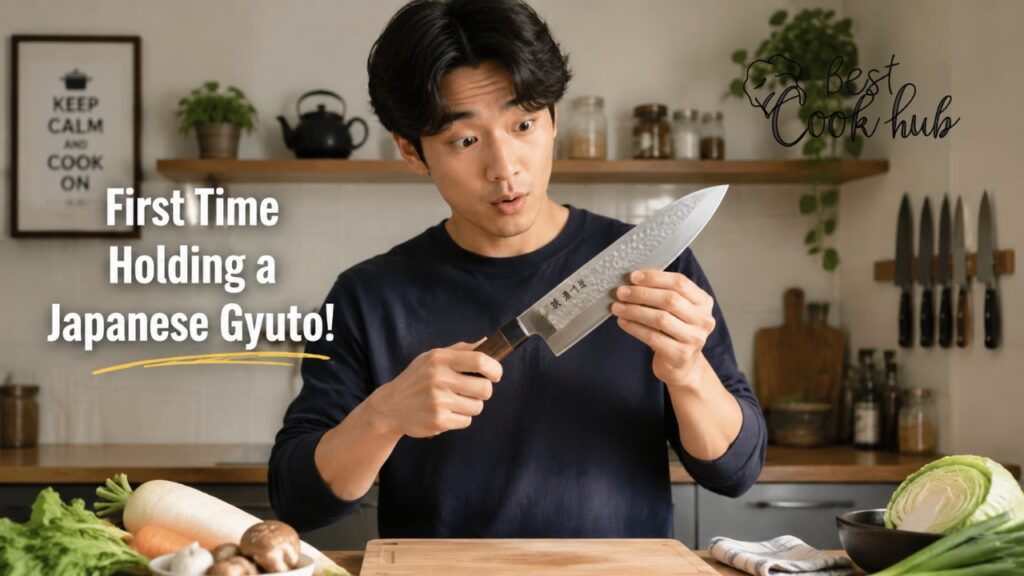
Why Japanese Cooking Knives Are So Special
Japanese kitchen knives are known for sharpness, precision, balance, and purpose-driven design. Many Japanese blades are thinner and harder than typical Western knives, which helps them make cleaner cuts with less pressure. That clean cut matters more than most people think. When vegetables are crushed instead of sliced, they lose texture, moisture, and visual appeal.
Have you ever chopped herbs and noticed dark, bruised edges? That often happens because the knife is dull or too thick. Japanese knives are also highly specialized. Instead of one knife doing everything poorly, each blade shape is designed to do one job very well. A yanagiba slices sashimi in one long pull. A nakiri cuts vegetables straight down. A deba breaks down fish with weight and strength. Once you understand the difference, choosing a Japanese knife becomes much easier.
Quick Guide: Which Japanese Knife Should You Buy First?
If you cook normal home meals, start with either a gyuto or santoku. These are the most practical Japanese chef knife styles for daily use. A gyuto is best if you want one knife for meat, vegetables, fish, herbs, and general prep. It feels like a Japanese version of a Western chef’s knife.
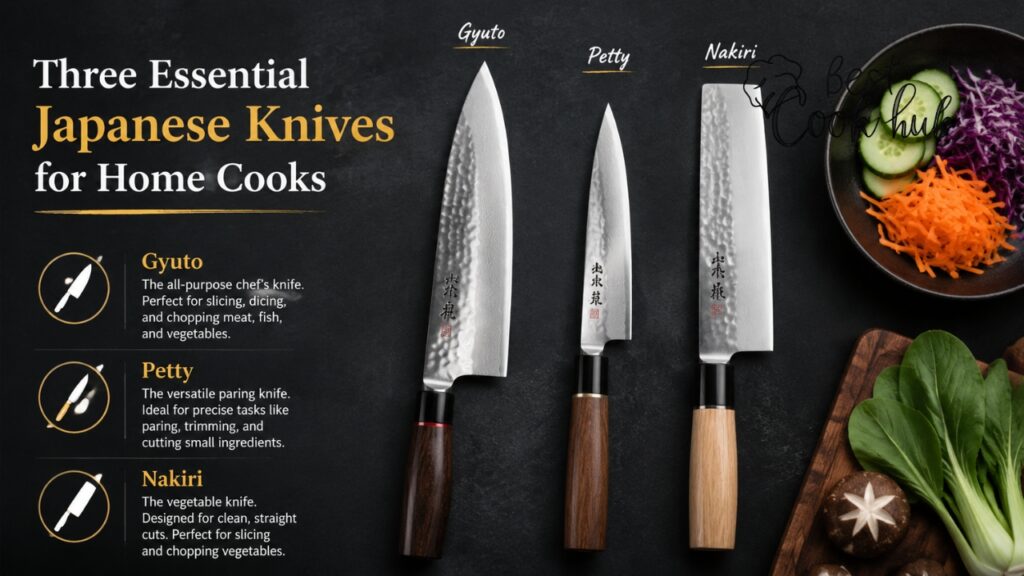
A santoku is great if you prefer a shorter, lighter, easy-control knife. It works beautifully for slicing, dicing, and mincing. If you cook lots of vegetables, add a nakiri. If you cook fish often, consider a deba and yanagiba later. Do you really need ten Japanese knives? No. For most home cooks, three knives can handle almost everything: a gyuto or santoku, a petty knife, and a nakiri or bread knife.
Japanese Knife Terms You Should Know
Before we go into the knife types, let’s clear up a few terms. These words appear often when shopping for Japanese cutlery. Single bevel means the knife is sharpened mainly on one side. Traditional Japanese knives like yanagiba, deba, and usuba are often single bevel. Double bevel means both sides of the blade are sharpened. Gyuto, santoku, nakiri, petty, bunka, and sujihiki are usually double bevel. Single bevel knives can make extremely precise cuts, but they need more skill. Double bevel Japanese knives are easier for beginners and more flexible for daily cooking.
Rockwell hardness, often written as HRC, measures steel hardness. Many Japanese knives fall around 58–65 HRC, depending on the steel and maker. Harder steel can hold a sharp edge longer, but it may be more brittle. That is why Japanese knives should not be twisted, thrown in the sink, or used on bones unless the knife is designed for that job.
1. Gyuto Knife: The Japanese Chef Knife
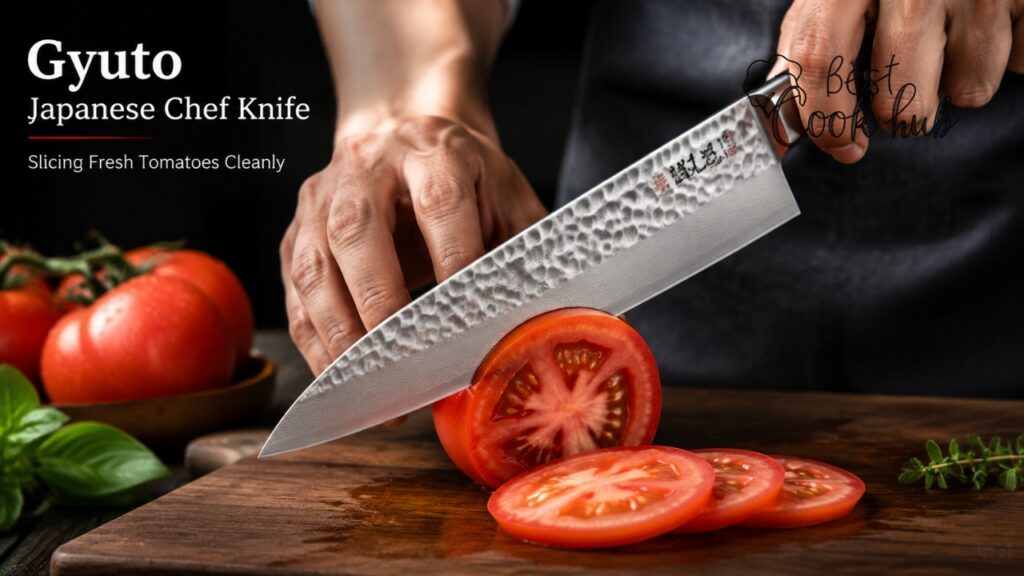
The gyuto is one of the most useful Japanese cooking knives. The name is often translated as “beef sword,” but today it works as an all-purpose Japanese chef knife. A typical gyuto is around 180mm to 270mm long. For most home cooks, 210mm is the sweet spot.
The gyuto is excellent for slicing meat, chopping vegetables, mincing herbs, cutting fruit, and preparing fish fillets. If you want one serious Japanese knife, this is usually the safest choice. Have you ever used a big chef’s knife that felt tiring after ten minutes? A gyuto often feels lighter and more agile. The blade usually has a gentle curve, so you can use a push cut, pull cut, or light rocking motion. Just avoid aggressive bone chopping.
Cooking tip: Use a gyuto for onions, carrots, chicken breast, herbs, tomatoes, cabbage, and boneless meat. Keep the blade moving forward and down instead of smashing straight into the board.
2. Santoku Knife: The Friendly All-Rounder
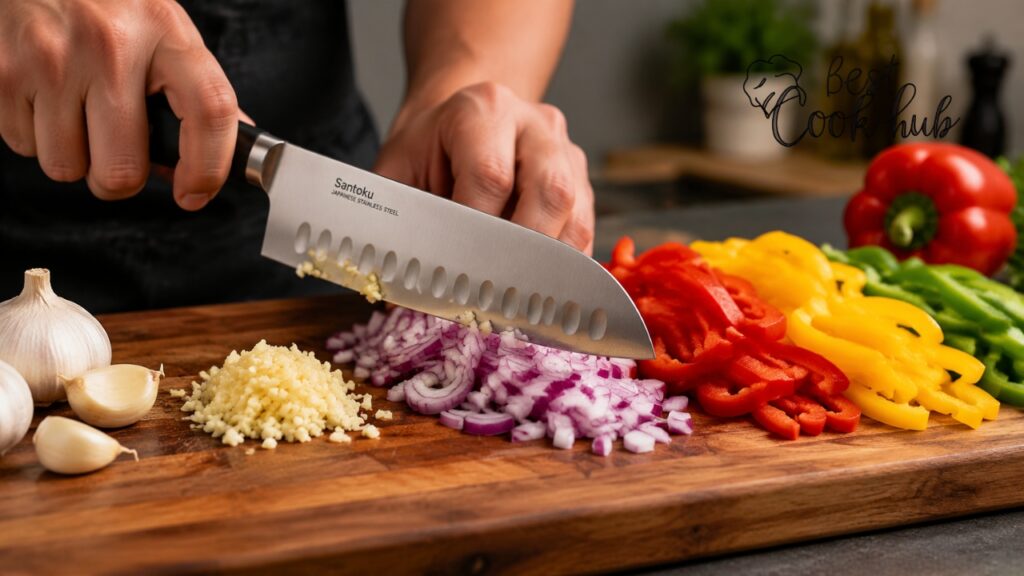
The santoku is one of the best Japanese knives for beginners. It is shorter than many gyuto knives and usually feels easy to control. Santoku means “three virtues” or “three uses.” Many cooks understand this as slicing, dicing, and mincing, or as handling meat, fish, and vegetables. A typical santoku is around 5 to 7 inches long. That makes it comfortable for small kitchens, smaller hands, and quick weekday cooking.
Does your kitchen counter feel crowded? A santoku may feel less intimidating than a long chef’s knife. The santoku usually has a flatter edge and a sheepsfoot-style tip. This makes it strong for push cutting and clean chopping. Food Network and Allrecipes both treat the santoku as a practical everyday kitchen knife, and that matches real kitchen experience. It is simple, balanced, and easy to love.
Cooking tip: Use a santoku for garlic, onions, boneless chicken, mushrooms, peppers, fish fillets, cheese, and quick stir-fry prep.
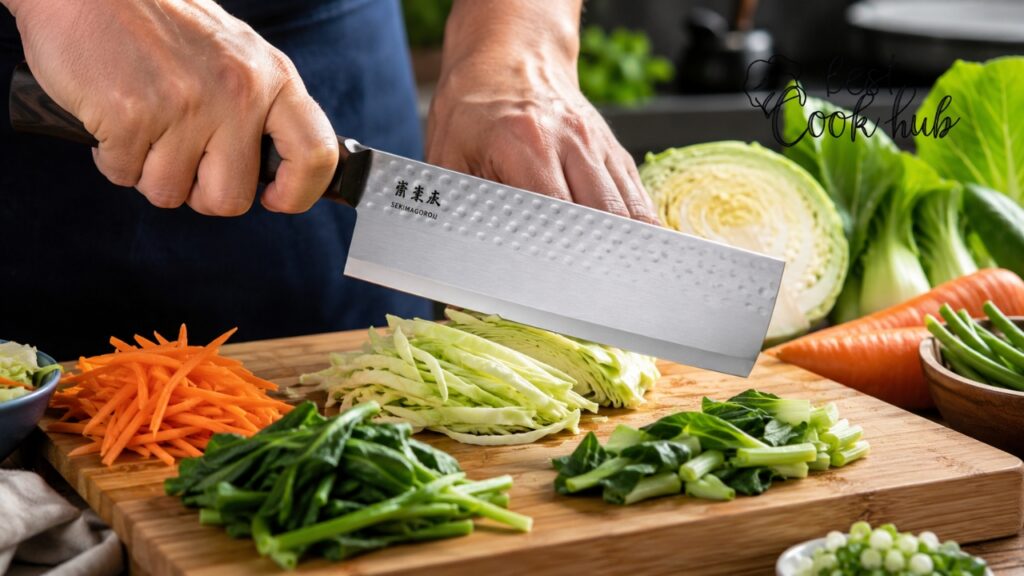
3. Nakiri Knife: The Vegetable Specialist
The nakiri is a Japanese vegetable knife with a rectangular blade and straight edge. It may look like a small cleaver, but it is not meant for bones. This knife is built for clean up-and-down vegetable cuts. It shines with cabbage, carrots, cucumbers, eggplant, zucchini, potatoes, and leafy greens.
Have you ever tried cutting a stack of greens and found half the leaves still connected? A nakiri helps solve that problem. Because the edge is flat, it contacts the cutting board evenly. This gives you clean slices without needing a rocking motion. A nakiri is usually around 160mm to 180mm long. It is one of the most enjoyable Japanese knives for home cooks who prepare lots of vegetables.
Cooking tip: Try a nakiri for thin cucumber slices, diced onions, shredded cabbage, and vegetable meal prep. Use a smooth push-down motion and let the blade glide through.
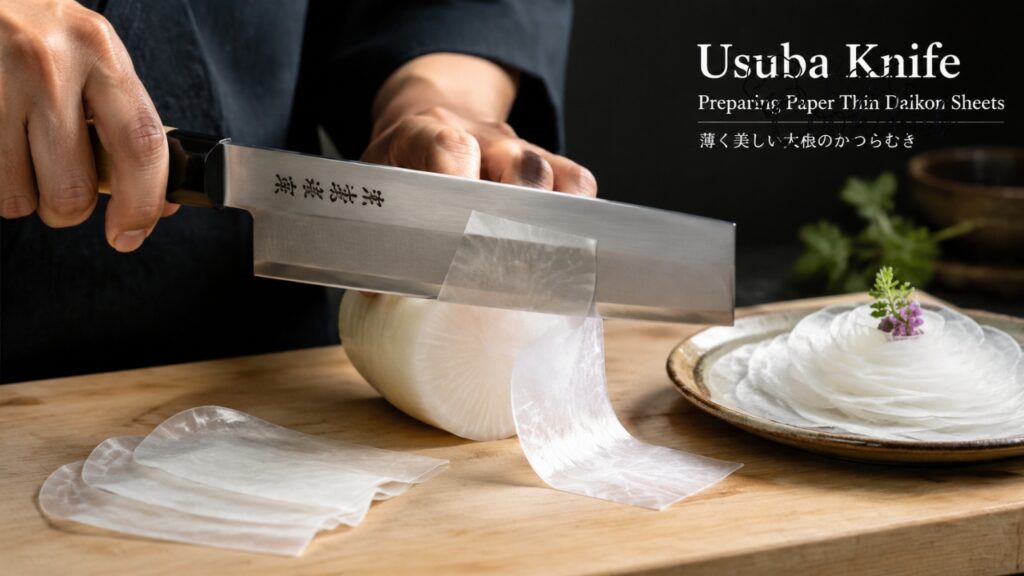
4. Usuba Knife: The Traditional Vegetable Master
The usuba is also a Japanese vegetable knife, but it is more traditional and more advanced than a nakiri. It is usually single bevel and extremely precise. Professional Japanese chefs use the usuba for delicate vegetable work. It is famous for katsuramuki, a technique where vegetables like daikon are peeled into long, paper-thin sheets.
Does that sound like something you would do on a busy Tuesday night? Probably not. That is why most home cooks should choose a nakiri before an usuba. The usuba is beautiful, but it demands skill and careful sharpening. A typical usuba may be around 180mm to 210mm long. It can cut vegetables with stunning accuracy when used correctly.
Cooking tip: Choose an usuba only if you enjoy traditional Japanese cooking, precision vegetable cuts, or serious knife practice.
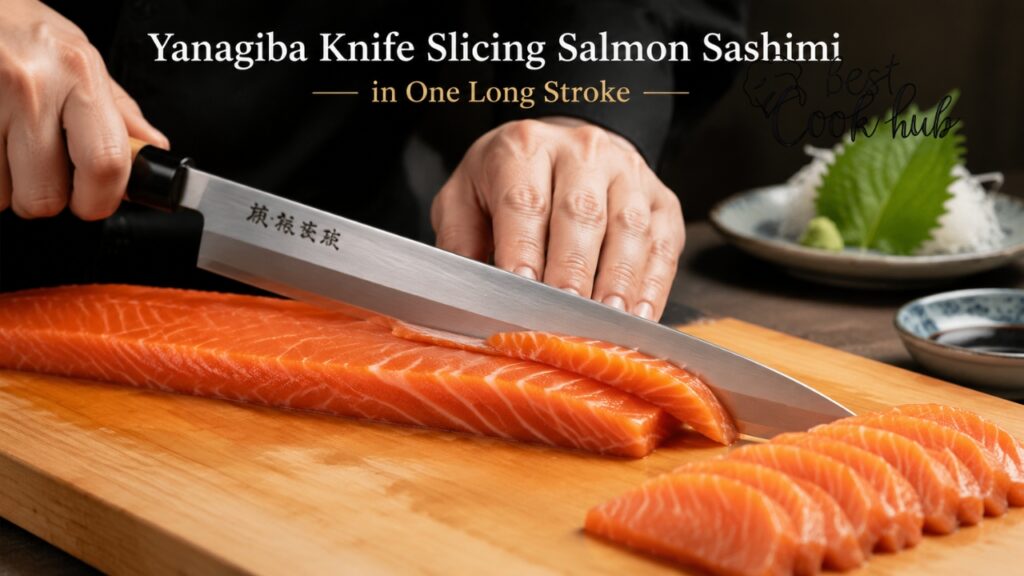
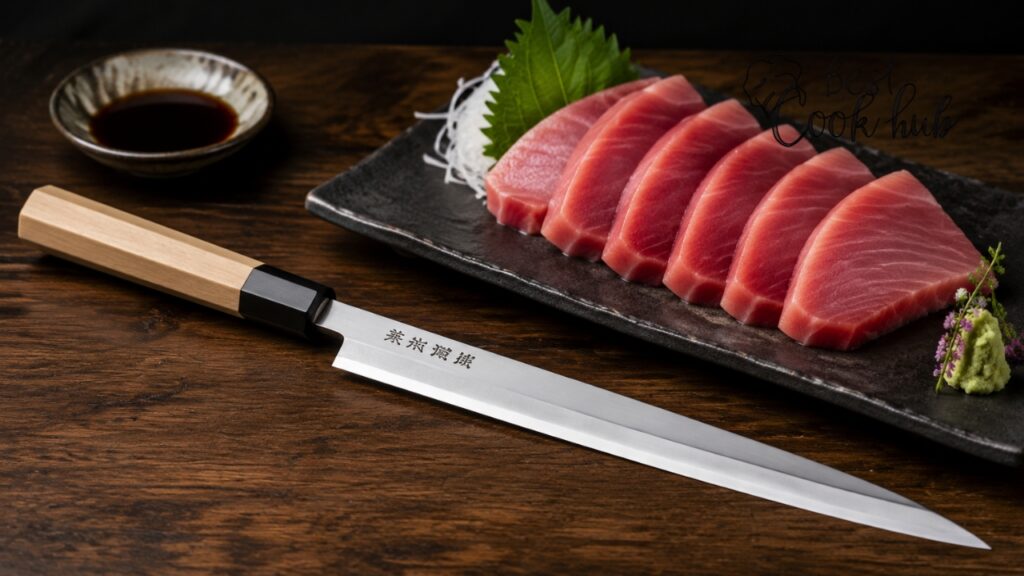
5. Yanagiba Knife: The Sashimi and Sushi Slicer
The yanagiba is the classic Japanese sashimi knife. It has a long, narrow blade made for slicing raw fish in one smooth pulling stroke. If you love sushi, have you ever noticed how clean and glossy good sashimi looks? That finish comes from sharpness, technique, and the right knife. A yanagiba usually ranges from 240mm to 330mm. The length allows the cook to slice fish without sawing back and forth.
This matters because sawing can tear delicate fish fibers. A yanagiba preserves texture and presentation. Most yanagiba knives are single bevel. That makes them powerful for precision slicing but less beginner-friendly than a gyuto or santoku.
Cooking tip: Use a yanagiba only for boneless fish fillets, sashimi, sushi toppings, and delicate slicing. Do not use it for bones, frozen food, or hard vegetables.
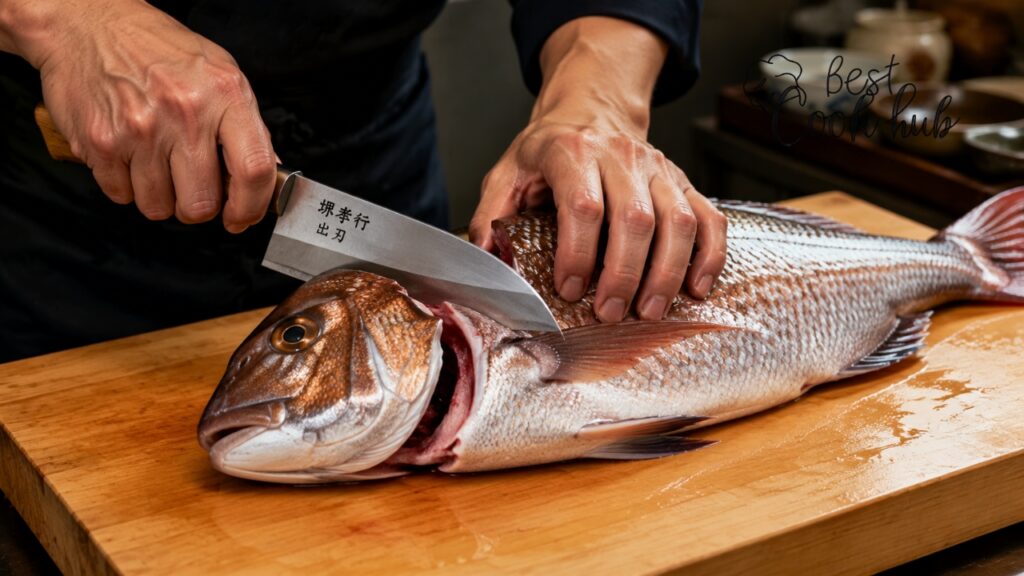
6. Deba Knife: The Fish Butchery Knife
The deba is a thick, heavy Japanese knife used for fish butchery. It is designed for tasks like removing heads, cutting through small fish bones, and filleting whole fish. This is not a general-purpose chef knife. It is strong, but the edge still needs respect.
Have you ever tried breaking down fish with a thin chef knife? It can feel unsafe, slippery, and frustrating. A deba gives you weight and control. The thick spine helps with fish heads and fish frames, while the sharp edge handles filleting. Deba knives often range from 150mm to 210mm. Smaller deba knives suit small fish, while larger ones handle bigger fish.
Cooking tip: Use the heel of the deba for tougher fish areas and the front section for cleaner fillet cuts. Never twist the blade hard inside bones.
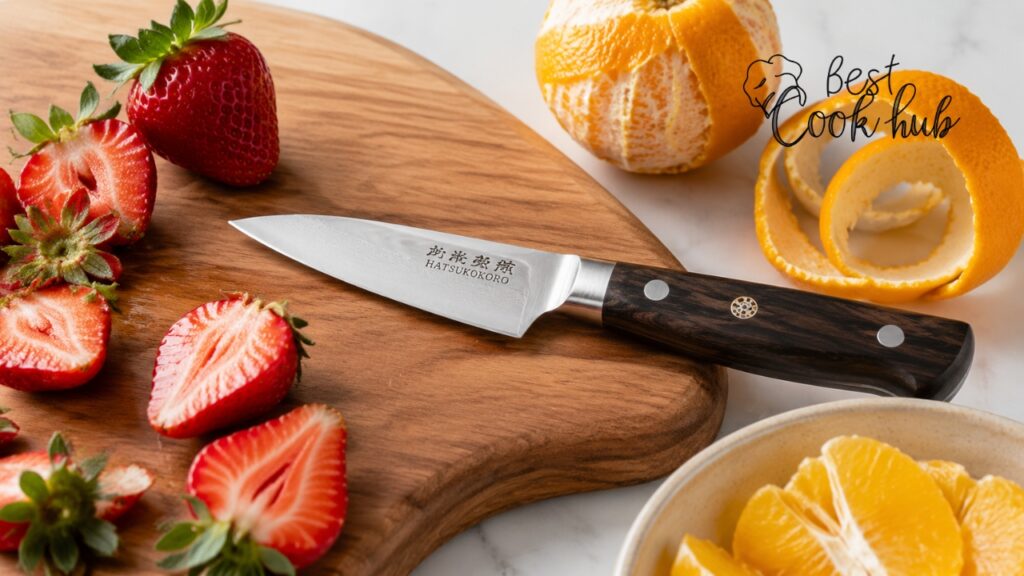
7. Petty Knife: The Small Utility Hero
The petty knife is the Japanese version of a small utility knife or paring knife. It is one of the most useful blades in any kitchen. A typical petty knife is around 120mm to 150mm. It handles jobs that feel too small for a gyuto or santoku.
Think peeling fruit, trimming strawberries, cutting shallots, deveining shrimp, slicing garlic, and cleaning small vegetables. Have you ever tried peeling an apple with a large chef knife? It works, but it feels awkward. That is where the petty knife feels perfect. It gives control, accuracy, and safety for small tasks.
Cooking tip: Keep a petty knife near your prep station for quick detail work. It saves time because you do not need to use your large knife for every tiny cut.
8. Sujihiki Knife: The Meat and Fish Slicer
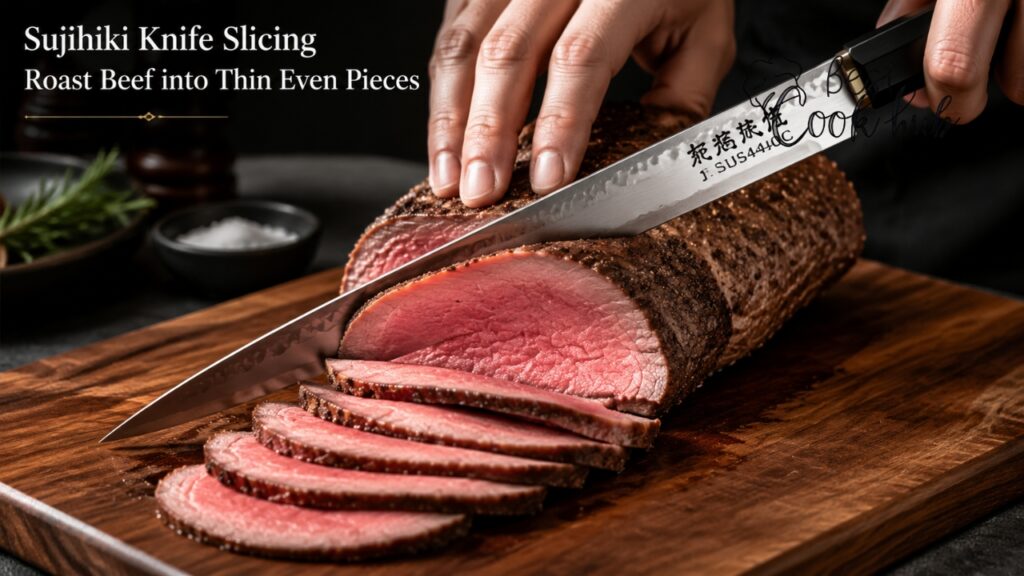
The sujihiki is a long, narrow Japanese slicing knife. It is often compared to a Western carving knife or a double-bevel alternative to the yanagiba. This knife is excellent for slicing roasts, brisket, turkey, ham, boneless fish fillets, and cooked meats. It creates long, clean slices with little drag.
Have you ever cooked a roast beautifully, then ruined the slices with a short knife? A sujihiki helps avoid that. A typical sujihiki is around 240mm to 300mm. The long blade allows fewer strokes and cleaner presentation. Unlike the yanagiba, the sujihiki is usually double bevel. That makes it easier for many home cooks.
Cooking tip: Use the full length of the blade in a smooth pull. Avoid pressing down too hard, because pressure can squeeze juices out of meat.
9. Kiritsuke Knife: The Ambitious Multi-Purpose Blade
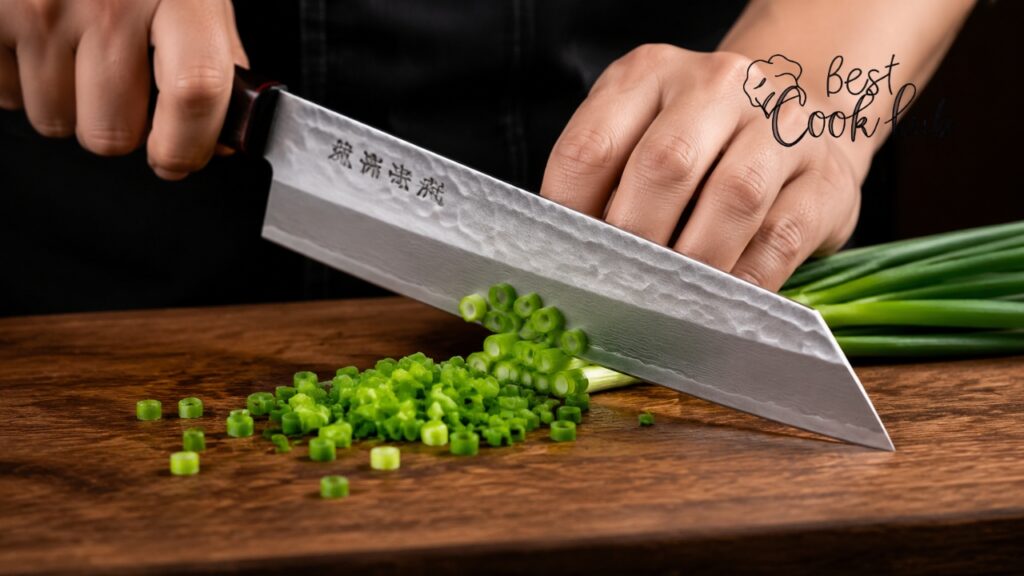
The kiritsuke is one of the most eye-catching Japanese knives. It often has a long blade and angled tip that looks sharp, bold, and elegant. Traditionally, a single-bevel kiritsuke was used by experienced chefs. It could perform tasks similar to a yanagiba and usuba. Modern double-bevel kiritsuke-style knives are more beginner-friendly. These are often used like a gyuto with a flatter profile and pointed tip.
Do you like precision cuts and a dramatic-looking blade? A kiritsuke may be tempting. Still, it is not always the best first knife. The tip can be delicate, and the flatter edge may need better technique.
Cooking tip: Use a kiritsuke for vegetables, proteins, herbs, and careful slicing. Avoid rough chopping and hard ingredients that can damage the fine tip.
10. Bunka Knife: The Compact, Stylish Performer
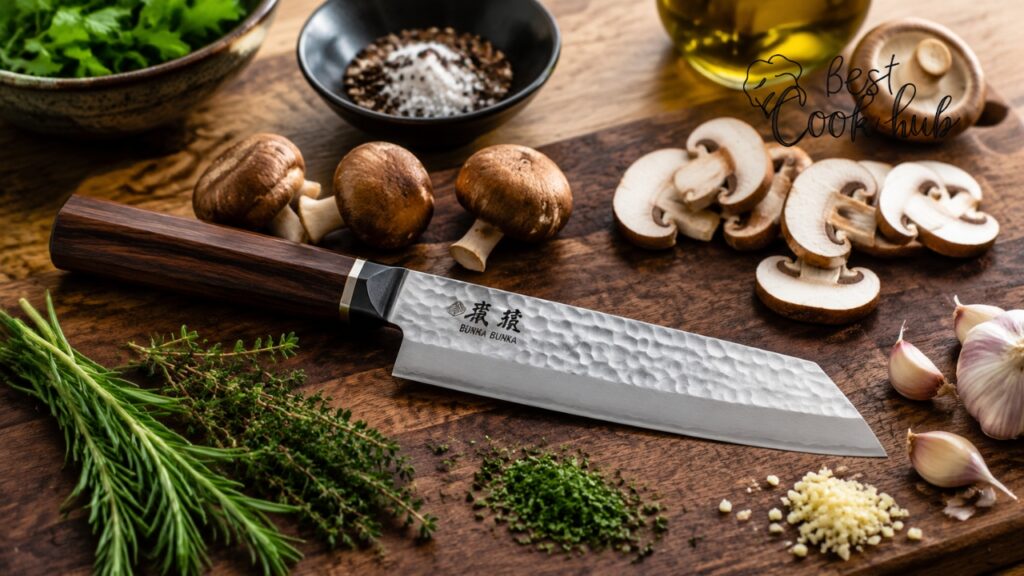
The bunka is a compact Japanese multi-purpose knife with a distinctive angled tip. It feels like a creative mix between a santoku and kiritsuke. It is great for home cooks who want one knife for vegetables, meat, fish, and fine tip work. The pointed tip helps with scoring, trimming, and detail cuts.
Have you ever wanted a knife that feels practical but still exciting? The bunka often gives that feeling. A common bunka length is around 165mm to 180mm. It is short enough for control but wide enough for vegetable prep. The blade profile is usually fairly flat. That makes it strong for push cutting and chopping.
Cooking tip: Use a bunka for onions, herbs, garlic, mushrooms, chicken breast, and decorative vegetable cuts. Protect the tip when washing and storing it.
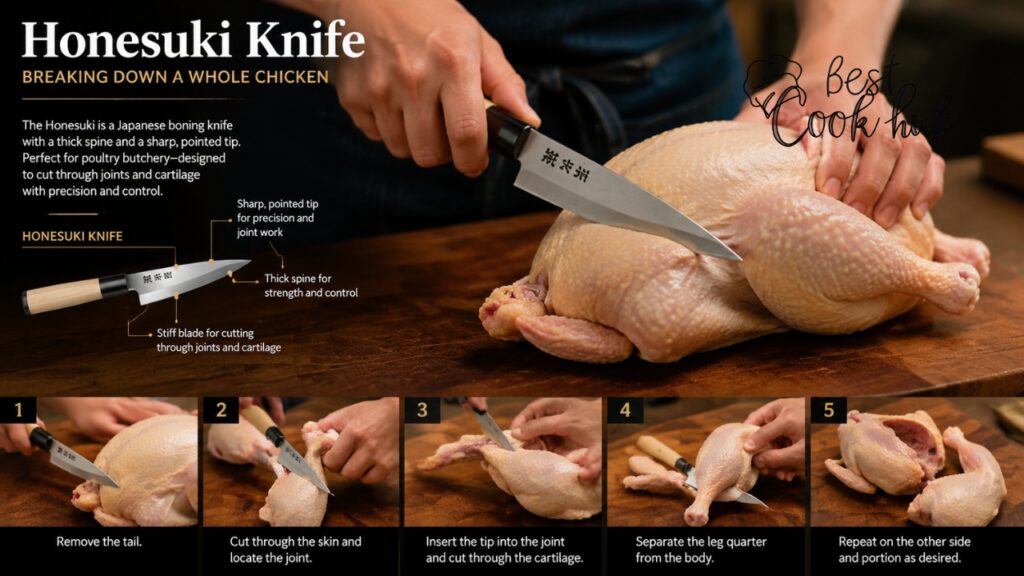
11. Honesuki Knife: The Poultry Boning Knife
The honesuki is a Japanese poultry boning knife. It has a triangular shape and a sharp tip for working around joints. This knife is especially helpful for breaking down chicken. It can separate thighs, remove breasts, and work around bones with control.
Have you ever paid more for pre-cut chicken because whole chicken felt difficult? A honesuki can make poultry prep easier. A honesuki is not used like a Western flexible boning knife. It is usually stiffer and more precise. Many honesuki knives are around 145mm to 165mm. The blade is compact but strong.
Cooking tip: Use the tip to locate joints and the heel for controlled pressure. Do not swing it like a cleaver.
12. Garasuki Knife: The Larger Poultry Knife
The garasuki is like a bigger, heavier sibling of the honesuki. It is used for larger poultry and heavier butchery tasks. This knife is less common in home kitchens. It is more useful for restaurants, butchers, or cooks who often process poultry.
If you only cook chicken once in a while, you probably do not need it. A honesuki will be easier to manage. The garasuki has more weight and power. That makes it helpful for larger birds and tougher prep.
Cooking tip: Choose a garasuki only if poultry butchery is a regular part of your cooking. For casual home use, start with a honesuki.
13. Takohiki Knife: The Tokyo-Style Slicer
The takohiki is a traditional Japanese slicer with a long, squared-off tip. It is often associated with the Tokyo region. Like the yanagiba, it is used for slicing fish and seafood. The shape is different, but the purpose is similar.
Some chefs like the squared tip for handling sliced fish neatly. Others prefer the graceful pointed shape of a yanagiba. For most home cooks, a yanagiba or sujihiki is easier to find and more practical. Still, the takohiki is an important part of Japanese knife history.
Cooking tip: Use a takohiki for precise seafood slicing, not for chopping or general prep.
14. Fugubiki Knife: The Ultra-Thin Fish Slicer
The fugubiki is a specialized Japanese knife used for slicing fugu, or pufferfish, extremely thin. It resembles a yanagiba but is usually thinner and more delicate. This is not a knife most home cooks need. It belongs in highly specialized Japanese cuisine.
Why mention it then? Because it shows how deeply Japanese knife design connects to food technique. When a cuisine has a knife for nearly transparent fish slices, you can see how seriously it treats texture and presentation.
Cooking tip: If you are not trained in traditional fish preparation, admire the fugubiki from a distance and choose a yanagiba or sujihiki for practical slicing.
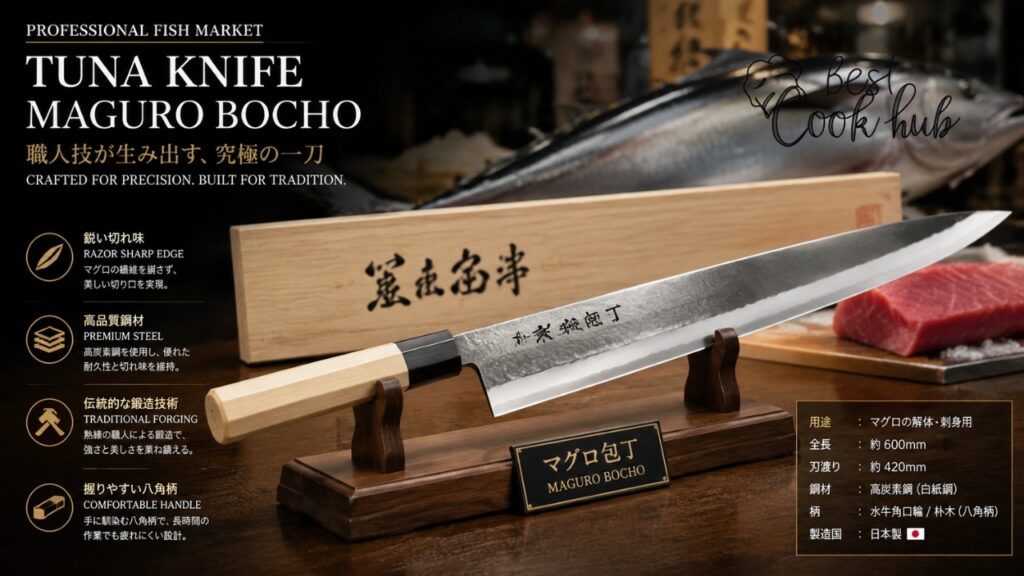
15. Maguro Bocho: The Giant Tuna Knife
The maguro bocho is a very long Japanese tuna knife. It can look almost like a sword. This knife is used for breaking down large tuna in fish markets and professional settings. It is not a normal home kitchen knife.
Have you seen videos of giant tuna being cut at Japanese markets? That is the kind of environment where a maguro bocho belongs. For everyday cooking, it is too large, too specialized, and unnecessary. But it is a fascinating example of Japanese blade craftsmanship.
Cooking tip: For home fish prep, choose deba for butchery and yanagiba or sujihiki for slicing.
Single Bevel vs Double Bevel: Which One Is Better?
Neither is automatically better. The right choice depends on your skill level and cooking style. Single bevel Japanese knives are highly precise. They are common in traditional knives such as yanagiba, deba, and usuba.
They can create beautiful cuts, but they need proper technique. They also need careful sharpening because the blade geometry is not the same on both sides. Double bevel knives are easier for most home cooks. Gyuto, santoku, nakiri, petty, bunka, and sujihiki are usually double bevel. If you are just starting, buy a double bevel Japanese knife first. You will enjoy it more and make fewer mistakes.
Carbon Steel vs Stainless Steel Japanese Knives
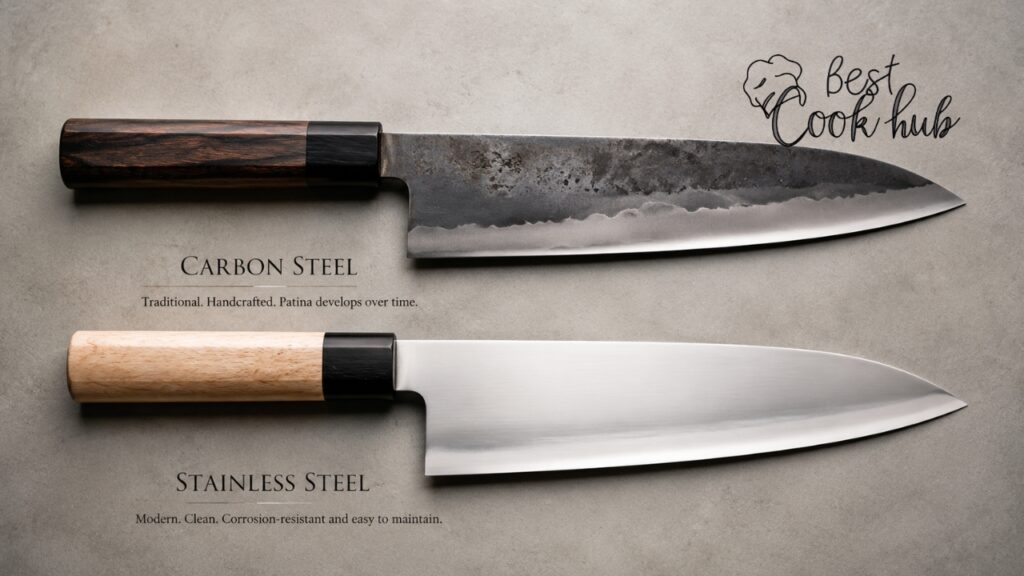
Japanese knives often come in carbon steel, stainless steel, or stainless-clad carbon steel. Each has a different personality. Carbon steel can become extremely sharp and is loved by many chefs. The trade-off is that it can rust or discolor if left wet. Stainless steel is easier to maintain. It is a smart choice for busy home cooks who do not want to wipe the blade constantly.
Stainless-clad carbon steel gives you a carbon cutting core with easier outer-layer maintenance. Many cooks see it as a balanced middle ground. Do you cook fast and leave dishes until later? Choose stainless steel first. Do you enjoy caring for your tools and wiping your knife after every ingredient? Carbon steel can be rewarding.
Best Japanese Knives for Different Cooking Styles
If you cook mostly vegetables, start with a nakiri or santoku. Add a petty knife for small prep. If you cook meat often, choose a gyuto and sujihiki. Add a honesuki if you break down chicken.
If you cook sushi or sashimi, choose a yanagiba. Add a deba if you prepare whole fish. If you cook everything, start simple. A gyuto, petty knife, and nakiri will cover most daily tasks. Does your cooking style change every week? Then choose versatile knives before specialized ones.
Japanese Knife Cutting Methods You Should Practice
A sharp Japanese knife works best when your technique matches the blade. You do not need fancy chef tricks, but a few methods help a lot. The push cut is great for gyuto, santoku, nakiri, and bunka. Move the blade forward and down through the food. The pull cut is useful for slicing meat, fish, and herbs. Draw the blade backward smoothly without sawing. The draw slice is essential for yanagiba and sujihiki. Use the full blade length in one clean motion.
The tap chop works well with nakiri and santoku for vegetables. Keep the motion controlled and even. The rock chop is more common with Western chef knives, but some gyuto knives can handle a gentle rock. Avoid forcing a flat Japanese blade into an aggressive rock motion.
Cooking tip: Try cutting one tomato with a dull knife and one with a sharp Japanese knife. You will immediately understand the difference.
Common Mistakes People Make with Japanese Knives
The first mistake is using a Japanese knife on bones, frozen food, or hard squash without checking if the knife is suitable. Thin, hard blades can chip. The second mistake is putting Japanese knives in the dishwasher. Heat, detergent, and movement can damage the handle and edge. The third mistake is cutting on glass, stone, ceramic, or metal boards. These surfaces can dull the edge quickly.
Use wood or quality plastic boards instead. Your knife will stay sharper longer. Another mistake is storing knives loose in a drawer. The blade can hit other tools and become damaged. Use a saya cover, magnetic strip, knife roll, or protected block. A sharp knife deserves a safe home.
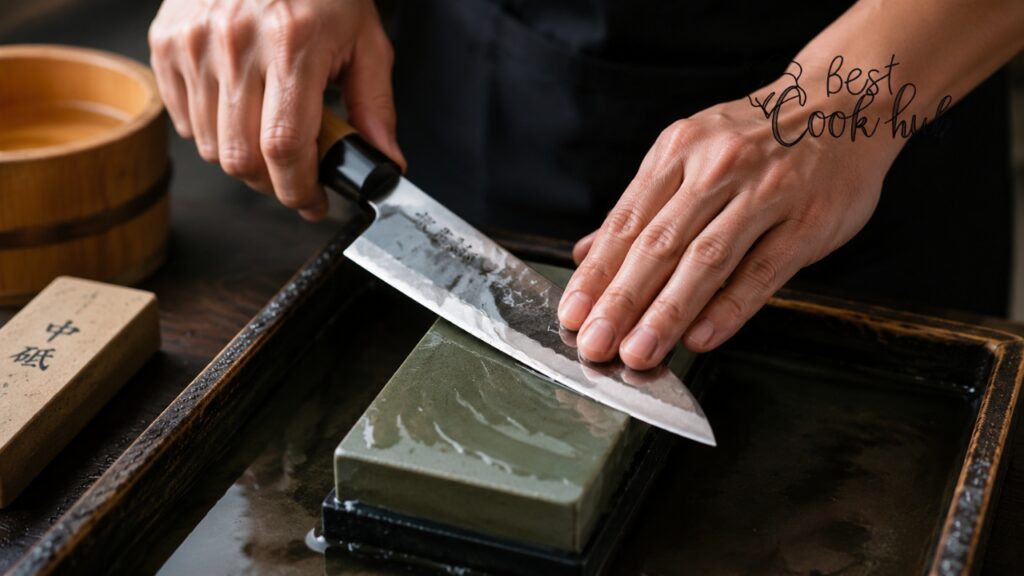
How to Sharpen Japanese Cooking Knives
A whetstone is the traditional and most respected way to sharpen Japanese knives. Many cooks start with a medium grit stone around 1000 grit. For polishing, a 3000 to 6000 grit stone can refine the edge. You do not need to buy every stone at once. Have you ever tried cutting with a freshly sharpened knife? It makes cooking feel lighter.
You can check this article: How Long Do Knife Sharpeners Last?
For double bevel knives, sharpen both sides evenly unless the maker says otherwise. For single bevel knives, learn the correct technique before sharpening. If you are nervous, use a professional knife sharpener who understands Japanese knives. A bad sharpening job can ruin the blade geometry.
Cooking tip: Do not wait until the knife is completely dull. Light maintenance is easier than repairing a dead edge.
How to Care for Japanese Knives Every Day
Wash your Japanese knife by hand right after use. Use mild soap, warm water, and a soft sponge. Dry it immediately with a towel. This is especially important for carbon steel knives. Do not leave the knife in the sink. That is bad for the blade and dangerous for anyone washing dishes.
Use the right cutting board. Wood and soft plastic are best for edge life. Store the knife safely. A blade guard or wooden saya is a great option if the knife goes in a drawer. If your knife has a wooden handle, keep it dry. A tiny amount of food-safe mineral oil can help maintain some wooden handles.
Japanese Knife Buying Guide for Beginners
Your first Japanese knife should match your actual cooking, not your dream kitchen fantasy. Be honest about what you cook most. If you cook normal family meals, buy a gyuto or santoku. If you cook lots of vegetables, add a nakiri. If you prep small fruit, garlic, shallots, or garnishes, buy a petty knife. It will quickly become one of your most-used tools.
Avoid buying a yanagiba first unless you truly prepare sushi or sashimi. It is beautiful, but it is not the most practical starting point. Avoid huge knife sets. Many people buy eight knives and only use two. A better plan is simple: buy one good all-purpose knife, learn it well, then add another knife when you feel a real need.
Simple Starter Sets Based on Skill Level
Beginner home cook: Santoku, petty knife, and bread knife.
Confident home cook: Gyuto, petty knife, and nakiri.
Fish lover: Gyuto, deba, and yanagiba.
Meat-focused cook: Gyuto, sujihiki, and honesuki.
Vegetarian or plant-based cook: Nakiri, gyuto, and petty knife.
Which set feels closest to your daily cooking? That answer tells you where to start.
You can also check this: Types of Kitchen Knives and Their Uses
Japanese Knife Comparison Table
| Knife Type | Best For | Common Length | Beginner Friendly? |
| Gyuto | All-purpose cooking | 180–270mm | Yes |
| Santoku | Everyday slicing, dicing, mincing | 5–7 inches | Yes |
| Nakiri | Vegetables | 160–180mm | Yes |
| Usuba | Traditional vegetable precision | 180–210mm | No |
| Yanagiba | Sushi and sashimi | 240–330mm | No |
| Deba | Fish butchery | 150–210mm | Medium |
| Petty | Small prep and trimming | 120–150mm | Yes |
| Sujihiki | Meat and fish slicing | 240–300mm | Yes |
| Kiritsuke | Advanced multi-purpose cuts | 210–270mm | Medium |
| Bunka | Compact all-purpose prep | 165–180mm | Yes |
| Honesuki | Poultry butchery | 145–165mm | Medium |
| Garasuki | Larger poultry butchery | 180mm+ | No |
What Reputable Cooking Sources Say
Trusted cooking platforms like Allrecipes and Food Network often recommend practical knife choices over oversized knife sets. That matches what many cooking instructors and working chefs tell beginners. A santoku is often praised because it handles common home prep with control. A chef-style knife, whether gyuto or Western chef knife, remains one of the most useful blades in the kitchen.
Korin, a respected Japanese knife retailer and educational source, separates Japanese knives into traditional task-specific knives and Western-influenced Japanese styles. This is helpful because it explains why some Japanese knives are easy for beginners while others require training. The lesson is simple. Buy the knife that fits your food, your hands, and your habits.
Final Buying Advice from the Kitchen
In my years of experience, the happiest cooks are not the ones with the biggest knife collection. They are the ones who understand their tools. A gyuto can make you faster. A santoku can make daily cooking easier. A nakiri can make vegetable prep feel clean and satisfying. A yanagiba can turn fish slicing into an art. A deba can make fish butchery safer and more controlled.
The right Japanese cooking knife gives you confidence. It makes you stand a little taller at the cutting board. So ask yourself one simple question: what do I cook most often? Start there. Choose the knife that supports your real kitchen life, practice slowly, care for the blade, and your cooking will improve one clean cut at a time.
FAQ
What is the best Japanese cooking knife for beginners?
If you cook a mix of meat, fish, and vegetables, choose a gyuto. If you want a compact everyday knife, choose a santoku.
What is the difference between a gyuto and a santoku?
A santoku is usually shorter with a flatter edge. It is excellent for slicing, dicing, and mincing in small or medium kitchens.
Do I need a nakiri if I already have a chef knife?
If you cook lots of cabbage, carrots, onions, cucumbers, and leafy greens, a nakiri is worth considering.
Are Japanese knives harder to maintain?
Carbon steel Japanese knives need extra drying because they can rust. Stainless Japanese knives are easier for busy home cooks.
Can I use Japanese knives for everything?
Use the right knife for the job. A gyuto or santoku handles general prep, a deba handles fish butchery, and a yanagiba handles sashimi slicing.
Leave a Reply